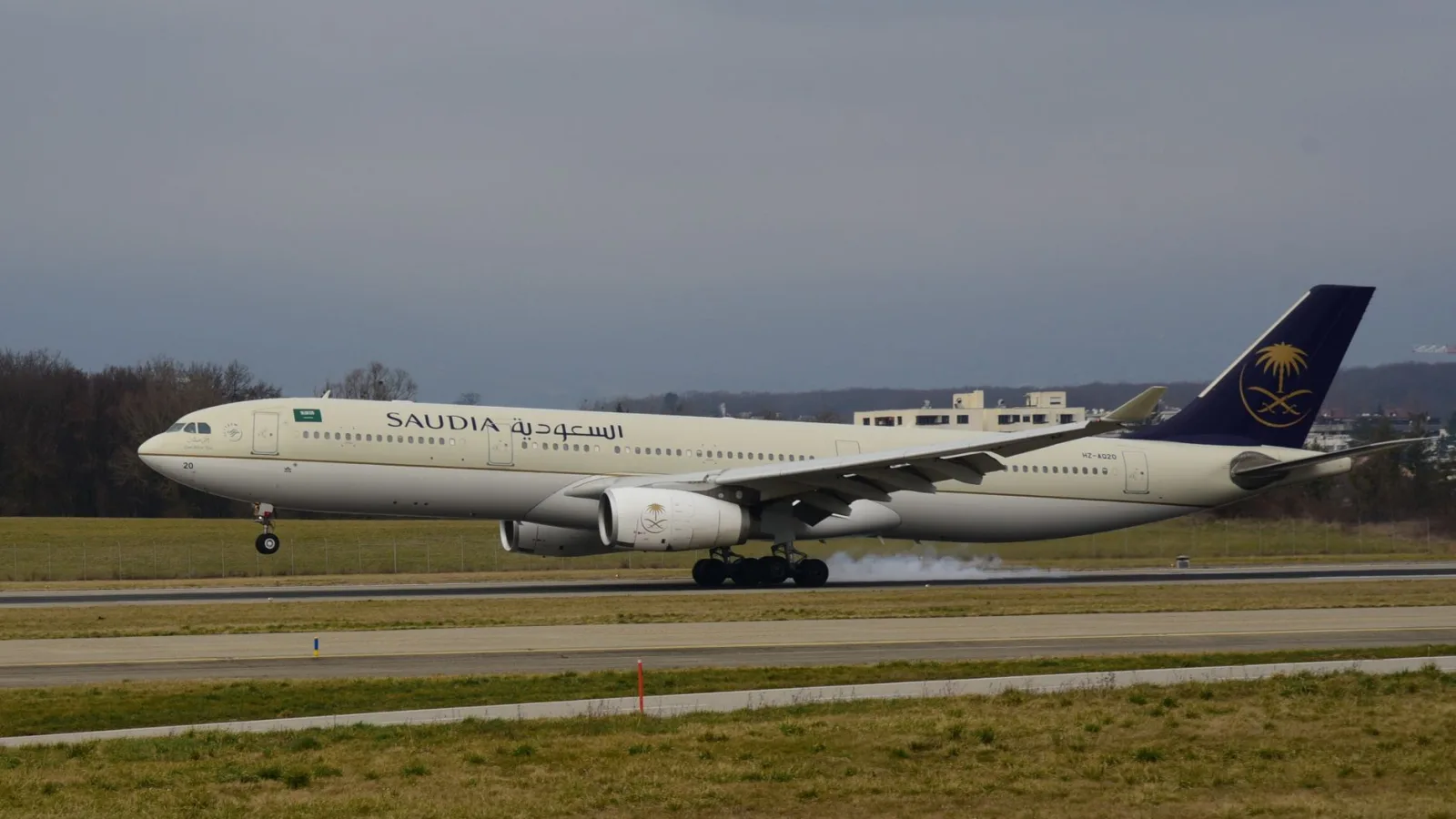
A Saudia Airlines plane was reportedly damaged by a ballistic missile strike at Riyadh's King Khalid International Airport on Thursday, an attack claimed by Yemen's Iran-backed Houthi rebels. The incident led to significant disruption, with almost half of scheduled departures from the Saudi capital's airport cancelled by 1500 GMT yesterday, and further cancellations expected for Friday across Saudi airports.
According to Reuters, which cited sources, the parked Saudia Airlines aircraft caught fire and sustained severe damage. Major international carriers, including Air India and Lufthansa, subsequently suspended flights to the Saudi capital following the reported strike.
Saudi Arabia has not issued a comment regarding the latest Houthi claim. However, the kingdom had previously confirmed that three individuals were killed in separate strikes on Riyadh and Abha airports earlier this week.
The Houthi rebels assert that their actions against Saudi Arabia are in response to the kingdom's support for Yemen's internationally recognised government in the ongoing civil war. A military spokesperson for the group also issued a warning on Wednesday for workers to avoid Saudi oil facilities, renewing threats against airlines and airports amidst escalating violence.
The reported strike occurred as US President Donald Trump stated that "productive discussions" were underway with the Islamic Republic of Iran. In a statement posted on Truth Social on Thursday evening, Mr Trump indicated that the United States would not launch an attack on Iran "at any time prior to the Midterm Elections to be held in the United States on November 3rd."
The President's comments also reiterated that the US blockade of Iranian ports remained in effect, while confirming that oil was flowing through the Strait of Hormuz.
Earlier on Thursday, Mr Trump defended controversial remarks made at a Monday rally in Nebraska, where he appeared to suggest Iran could target US cities. He had stated, "They could take out a city. Let them take out Los Angeles; let them take out San Diego." The White House later clarified that these remarks were intended to address the threat a nuclear-armed Iran could pose.
In his Truth Social post, Mr Trump refuted what he termed "Fake and Artificial News" attempting to misrepresent his comments. He clarified that he was highlighting how a temporary increase in petrol prices, linked to a blockade of the Strait of Hormuz, was a "small price to pay for Iran not having a Nuclear Weapon," contrasting it with the "big price" if cities like San Diego or Los Angeles were bombed.
The broader context of US military operations linked to the conflict with Iran continues to unfold. The USS Abraham Lincoln aircraft carrier, which had supported US operations in Iran and spent a record 265 days at sea, has docked in San Diego, California. Its deployment had drawn attention due to reports of crew stress, mental health concerns, and supply shortages, though these were reportedly downplayed by Pentagon officials.
A Congressional Research Service report indicates that 81 fixed-wing or rotary-wing aircraft, with an estimated value of up to $3.3 billion, have been damaged or destroyed in what it describes as President Donald Trump’s "Operation Epic Fury" airstrikes against Tehran, launched on 28 February. Casualties reportedly include an F-35A fighter jet and a four-engine E-3 Sentry, with MQ-9 Reaper drones accounting for over half of the losses.
Meanwhile, concerns have been raised in Europe regarding potential covert attacks. The German news outlet WirtschaftsWoche reported on Thursday that Iranian intelligence services are targeting US military installations in Germany, including Ramstein and Spangdahlem air bases, amid fears of covert operations linked to the Iran conflict. The report cited several unnamed Western intelligence officials.
Three weeks prior, Israel had reportedly warned US and German partners of a potential threat, with particular focus on bases supporting American military operations and logistics related to the conflict. A US European Command Spokesperson declined to comment on specific threat reporting but affirmed the Command's vigilance and continuous assessment of the security environment. The German defence ministry also declined comment, while a Reuters source confirmed Germany has been monitoring increased Iranian activity for weeks.
Adding to regional tensions, Iranian media outlet Fars news agency, citing unnamed military sources, reported "massive explosions" in the southern Strait of Hormuz. The report suggested that tankers using "unauthorised" routes may have struck sea mines.