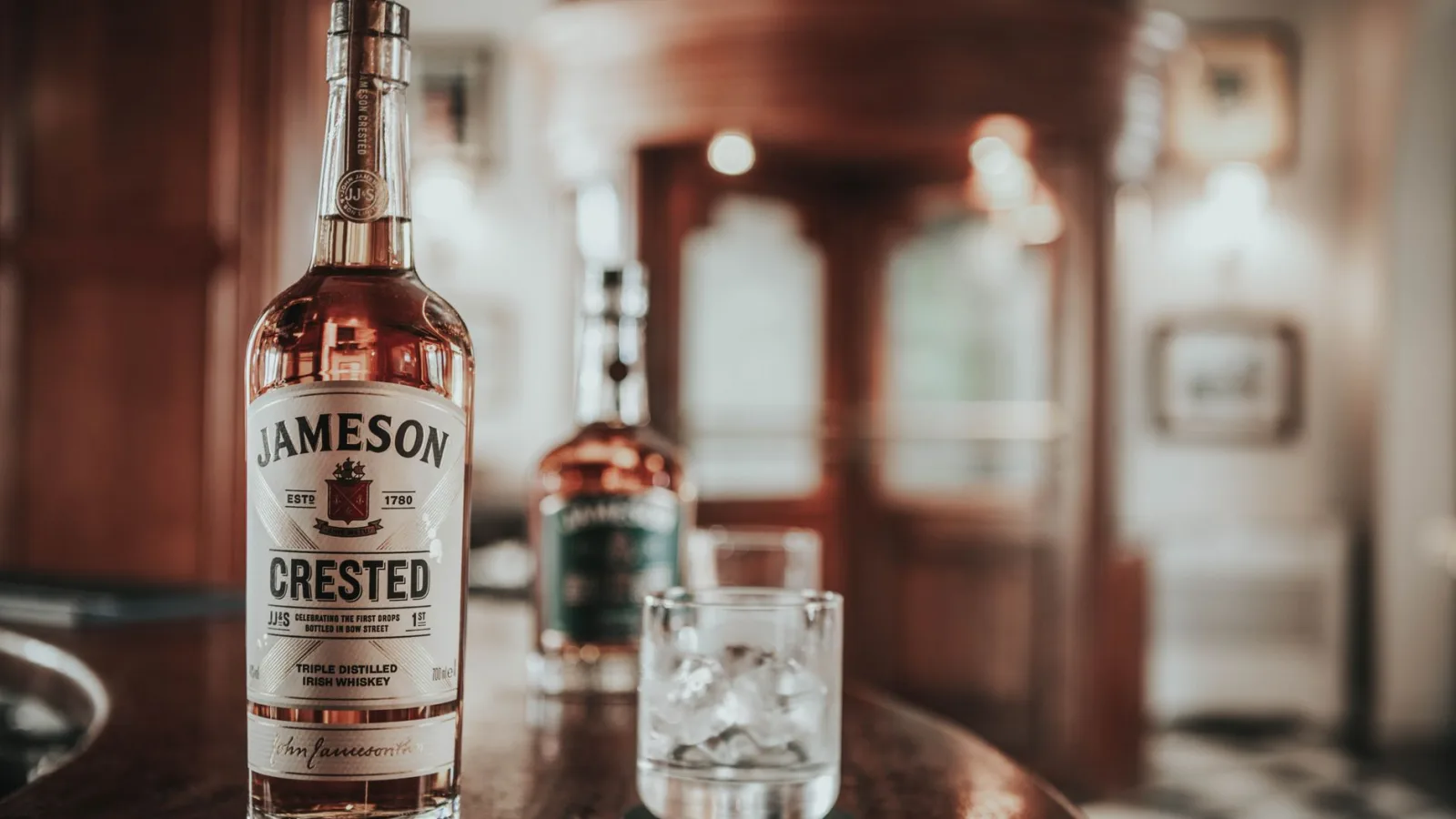
US President Donald Trump announced the removal of all tariffs on Irish whiskey as his two-day visit to Ireland concluded. The announcement was made amidst his attendance at the Irish Open and follows his reiterated support for a united Ireland, which garnered mixed reactions from political figures and the public.
Currently, whiskey distilled in the Republic of Ireland is subject to a 15% tariff when entering the US, a standard measure applied to EU goods. In contrast, whiskey produced in Northern Ireland or other parts of the UK has no such tariff. Mr Trump confirmed the tariff removal before presenting the winner's trophy to Irish Open champion Shane Lowry at the Trump International golf resort in Doonbeg, County Clare.
"They are saying would you do me a favour? It's so unfair what's going on. Could you possibly take the tariffs off of Irish whiskey and I said, on behalf of the United States of America, I am going to take the tariffs off Irish whiskey," Mr Trump stated, recounting discussions with Taoiseach Micheál Martin and golfer Lowry.
John Campbell, BBC News NI economics and business editor, provided analysis on the implications of the tariff removal. He noted that it would "end the advantage that some Northern Ireland distillers had over competitors in the Republic of Ireland." This advantage stemmed from the earlier removal of tariffs on all UK-made whiskey announced by Mr Trump in May.
Mr Campbell explained that "all-island supply chains" meant some Northern Irish whiskey brands could not fully benefit from the previous tariff cut. This is because newer distilleries often bottle whiskey produced by other companies while awaiting their own products to mature. The Great Northern Distillery in Dundalk, County Louth, is a dominant service provider in this sector, producing whiskey under licence for brands across the entire island. Consequently, Northern Irish distilleries bottling liquid from this Republic of Ireland-based facility were classified as EU rather than UK producers, therefore still subject to the 15% tariff. The lifting of tariffs on Irish whiskey is expected to harmonise conditions for producers across the island.
Throughout his visit, Mr Trump also reiterated his view on a united Ireland. On Saturday, in Dublin, during a meeting with Taoiseach Martin, he told reporters he "would love to see a united Ireland." He elaborated on Sunday at his Doonbeg golf resort, stating that putting Ireland and Northern Ireland "together" seemed "one of the naturals of all time." He described these comments as "a fairly routine comment," adding, "I've always loved the people of Ireland. It just seems to me you have Northern Ireland and Ireland. It seems that one of the naturals of all time is to put them together. That's only my opinion, and by the way many people agree."
The President chose not to comment on Scottish independence, stating, "I won't talk about Scotland yet I will save that." When questioned about Prime Minister Andy Burnham's stance that a poll on Irish unity would only occur if a majority in Northern Ireland were likely to vote in favour, Mr Trump responded, "Everybody says that and then things happen."
Taoiseach Micheál Martin acknowledged Mr Trump's remarks, stating they did not come as a "surprise" and reflected the President's "different sort of perspective on things." "He would make the point this is his view. He believes unity is the logical way for the island to be configured and organised," Mr Martin said, adding that he believed "some of the reaction is an overreaction."
Mr Trump spent the second day of his visit watching the final day of the Irish Open. On Saturday, he had met with Taoiseach Micheál Martin and Irish President Catherine Connolly in Dublin.
The presidential visit prompted significant public demonstrations. More than 10,000 people participated in a protest march in Dublin on Saturday, expressing opposition to the US President. On Sunday, approximately 100 protesters arrived in Doonbeg. Gardai (Irish police) reportedly moved a small crowd away from the President's hotel.
On Saturday evening, three women were arrested for trespassing on the golf links at Doonbeg and subsequently appeared at a special sitting of Ennis District Court.
Rev Steven Foster, a Methodist minister from Galway who attended the anti-Trump protest in Doonbeg, told BBC News NI: "I'm here because Trump is the exact opposite of everything I stand for as a follower of Jesus. As a church leader, it's important for me to be visible, and the church needs to be visible in this regard." He added that "the type of welcome he has been given sends out a terrible message."
Despite the protests, local business owners in Doonbeg praised the Trump International Golf Course for its economic contribution. Martin Kelly, a local businessman, described the village as "very fortunate" to have the golf course. "It's a massive employer here to be honest with you. There's nothing else about here at that scale; they're very decent people to work for, they're very fair," he told BBC News NI, adding that locals were "very proud" of the golf tournament taking place there.
Seoirse Comerford, who owns Comerford bar in Doonbeg, echoed these sentiments, describing the tournament as "unbelievable." He highlighted the golf course's role as a major employer, stating it was "keeping Doonbeg alive." "Most rural villages in west Clare are all dying a death, young people going away to college, they don't come back. Like there's over 300 people employed up there at the golf course, it's a big boost to the local economy. You've got big companies in Dublin, like Intel, the golf course is our Intel down here," Mr Comerford said.
Mr Trump boarded Air Force One at Shannon Airport following the trophy presentation, departing for Washington.